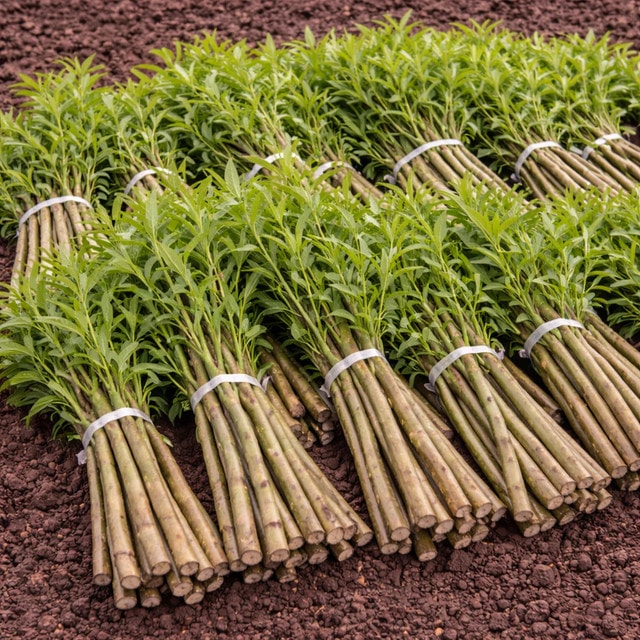
To protect fragile slopes, streambanks, and eroded locations, one does not need to install expensive infrastructure or artificial materials. Live stakes are cheap biological soil retention, soil erosion, and watershed protection devices. These hardy live stakes are essentially dormant cuttings of vigorous native shrubs and trees that settle quite rapidly in moist soils, hold the banks in place naturally, and enhance the soil structure in the long term. At Tree Nursery Co., we offer quality live stakes that will be highly relied on by restoration experts and homeowners.
What Are Live Stakes, and How Do They Work?
Live stakes are dormant woody cuttings of native species that have a fast growth rate and are collected in their dormant period. Planted in the correct site in damp soils, such cuttings will produce roots in weeks and leaves by late spring to form living erosion barriers that increase in strength each season. Contrary to the artificial barriers, which decay and have to be substituted, hardy live stakes develop permanent vegetation that enhances with age.
This process is successful because some of the native shrubs have the natural rooting hormones that work upon exposure to moisture by the cuttings. Roots anchoring out hold the soil particles together, forming networks that hold them together during storms. The USDA Natural Resources Conservation Service offers free planning materials and conservation criteria as technical advice on erosion control.
Why Live Stakes Are Essential for Soil Retention
Live stakes for erosion control are necessary, as they will prevent erosion. Their growing root systems physically stabilize soil on the steep slopes, streambanks, and construction sites in which erosion poses danger to property and water quality. Live stakes can prevent decades of soil movement as opposed to temporary silt fences, which can only delay its erosion.
Soil organisms also thrive on hardy live stakes, which enhance the microbial diversity as they grow. The beneficial bacteria are fed by their root exudates, and the seasonal leaf litter provides organic matter that naturally enhances soil structure.
Benefits of Using Live Stakes for Erosion Control
Live stakes for erosion control offer several advantages that cannot be matched by synthetic barrier erosion control. They are much less expensive than hardscape solutions and do not need heavy equipment or costly materials. The majority of species propagate fast with a survival rate well over 80%.
Live stakes also possess habitat value, which engineered solutions do not have. They can be used to provide shelter to birds when they grow up to shrubs, provide berries to feed wildlife, and provide food to pollinators with seasonal blooms. Their roots enhance the penetration of water and decrease the velocity of runoff.
Step-by-Step Guide to Planting Live Stakes Successfully
The proper tree-staking techniques ensure a good establishment of trees, as the best method is planting live stakes. The finest varieties of the Tree Nursery Co. are
Silky Dogwood Live Stakes
This is a native shrub that is wetland and possesses aggressive rooting properties, making it grow fast in moist soil and streambank environments. Silky Dogwood Live Stakes are amongst the most secure and hardy live stakes to be applied in riparian restoration, as they bear white spring flowers and also blue-black berries.
Elderberry Live Stakes
This is a rapid-growing native shrub that produces huge clusters of white flowers and dark berries that are favored by more than 50 bird species. The Elderberry Live Stakes are exceptional live stakes for erosion control, where the stabilization of soil is also a priority, as well as the wildlife value.
River Birch Live Stakes
This is a strong native tree that has peeling cinnamon-colored bark that can withstand wet conditions as well as periodic dry seasons. The River Birch Live Stakes are fast-growing and highly successful as live stakes along a streambank, a pond edge, and in places where water levels are unpredictable.
Hydrangea Live Stakes
It is a hardy shrub that flowers and grows large white flowers with roots that are fibrous and stabilize the soil. The Hydrangea Live Stakes are hardy live stakes that are perfect for shaded slope stabilization.
Button Bush Live Stakes
It is a native wetland shrub that grows and is very unique in that it has spherical white flowers and an extraordinary rooting ability in saturated soils. The Button Bush Live Stakes are one of the most suitable live stakes for sale in order to restore wetlands and stabilize the shorelines.
Planting Instructions Using Proper Tree Staking Techniques
Installation is successful by following these steps:
- Read the area: Clean up trash and indicate planting sites according to contour lines, every two to three feet.
- Plant posts correctly: Plant posts with tree staking techniques that plunge their posts two-thirds of the length into soil at slight angles of upwardness, with the third sticking out with their buds facing upward.
- Compaction of soil: Soil should be compacted firmly around all stakes to ensure that air does not enter it, but it is in contact with moisture.
Seasonal Care and Maintenance Tips
Live stakes require a constant water supply within the first year of growth to take root. Weekly water during the dry season in the first three months. The majority of the species root in four to six weeks and leaf out at the end of the spring to provide instant soil stabilization.
Hardy live stakes need very little taking care of once established. Keep a check on the competition of the invasive species in the first and second years and eliminate aggressive weeds. Fertilizing is not recommended because most native species do not need fertilizers. Tree Nursery Co. will include installation instructions with each live stake for sale.
Conclusion
Hardy live stakes are simple and economical tools to enhance soil retention, prevent soil erosion, and stabilize erosional hilly slopes. They establish themselves within a short period, develop stable vegetation, and contribute to the soil structure and health of watersheds in the long term. The wetland-loving Silky Dogwood, the wildlife-friendly Elderberry, the versatile River Birch, the shade-tolerant Hydrangea, and the saturated-soil specialist Button Bush, all varieties of Tree Nursery Co., are harvested dormant and root ready. Trust Tree Nursery Co. should supply high-quality live stakes that encourage erosion control that is sustainable.
FAQs
What are live stakes, and why are they used?
Live stakes are dormant woody cuttings that, when planted in damp soil, develop into living erosion barriers that are living and help stabilize slopes and streambanks.
Which live stakes are best for erosion control?
Some of the best live stakes that are used in erosion control are Silky Dogwood, Elderberry, and River Birch because they root aggressively and are flexible.
When is the best time to plant live stakes?
The period right after the end of winter and the onset of spring, when plants are still asleep, is the best time to install hardy live stakes before they start growing.
Do live stakes need watering after planting?
Yes, during dry seasons live stakes require watering once a week during the initial three months to facilitate root development.
Can live stakes grow in dry sites?
Most live stakes are most successful in wet or moist soils, although River Birch can endure periodic dryness after establishment.
How deep should live stakes be planted?
The hardy live stakes are to be inserted with staking in soil in appropriate tree staking methods, two-thirds of their length, leaving a third of the stake above the soil.
What soil conditions are best for live stakes?
Live stakes are used to control erosion in moist and well-draining soils that are making good soil enriched with organic matter at the edges of streams, slopes, and wetlands.